Showing posts with label Shaun Tan. Show all posts

Tuesday, 28 August 2012

Notes from Shaun Tan & Quentin Blake in Conversation, a Comica event hosted by Paul Gravett

A big thank you to Paul Gravett and Comica for getting two great artist-illustrators, Shaun Tan and Quentin Blake, who had never previously met, to talk together in public this evening in London.
I'm sure there'll be other fuller records of this interesting meeting with its unexpected bonus of a joint live drawing session.
Here are just a few things that grabbed me, which I want to get down while it's all still fresh.

What interests Quentin Blake in the process of drawing is finding out what he's drawing will look like.   "You'll have fun or trouble with this one"  is a thought he likes to have when he starts, avoiding easy, formulaic answers.

Both Shaun Tan and Quentin are happy to alter even their final drawing if needed.
They also both talked about the problem of a drawing being "too good".  Shaun has even sandpapered over a painting that feels too slick, too real. Likewise Quentin said, the important thing is not to get to the answer too easily.  You have to believe in it as a drawing, and if it's too real, too polished, perhaps it's harder to believe.  (This by the way, reminds me of something Matisse said about a painting needing to have a chink in it, some corner or bit that was troublesome, something not quite right that could give you a path into looking at it.)

Shaun nevertheless fights what he feels is his natural tendency to be too controlled.  He likes to work on a messed up surface - using collage, some colour or paint dribbles to break it up a bit.  The trouble with the computer, he says, is that you don't get suprised by accidents in the way you can drag a palette knife laden with paint and find something surprising emerge.  That said, he has to work digitally at some point for things like his film work. The real ideas start for Shaun when he 'stumbles over his own consciousness' at some point after all the emails, and worries about artistic failure (!) , visualizing things in tiny thumbnails, the smaller the freer.  He then blows them up on a light box, being too scared, he says, to work large...After working on it some length of time - he'll start to be convinced by it .  There's a certain stage of work when the conviction comes, a kind of leap of faith.   It's not there at the outset.

Quentin Blake talked about there being a lot of acting in drawing. And like an actor you can identify with your characters while maintaining a certain detachment, even if you are grimacing or growling.

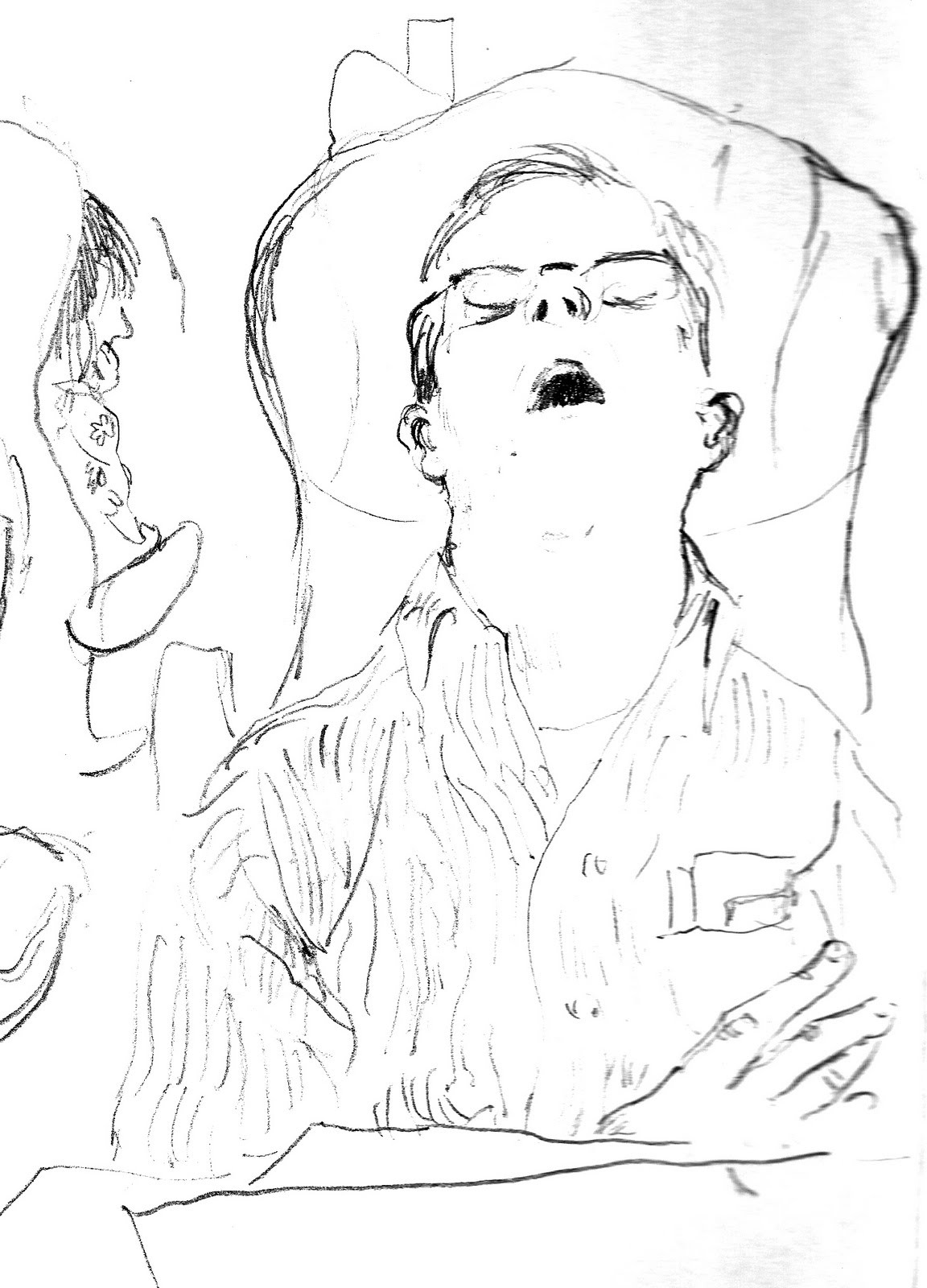
Shaun standing, Quentin sitting to draw
Both started out studying English literature at university, and in Shaun's case, art history and theory but it was the apprenticeship,  the 'doing', getting small drawing commissions, both from aged 16 that taught them the most about drawing.  

For Shaun drawing is an emotional thing.  He focuses on it feeling right. He can intellectualize about it afterwards.   Words, Shaun Tan says, have a set speed (he had a nice image of the the movement from words, like throwing pebbles into a still pool, that he didn't want for The Lost Thing) The wordless visual sequence in Blake's Clown or Tan's The Arrival, means the pace can be slower, so your eyes can bounce back, move around the page, at your own pace.

Another advantage to not being too realistic, removing certain descriptive details - is that it allows for more open-ended readings.   Shaun was touched by one interpretation of his book The Arrival,  about an immigrant arriving in an unfamiliar country.  One boy told him he read it as about going to school.  So the trope of immigration can also be about transition.   That open endedness is fine.

Shaun joked that from his uneventful life in the studio he can struggle with people facing situations that he would never want to face in real life.  Similar Quentin said the people he draws are active to make up for his own laziness (!).

Lazy?  Well I'd say both Shaun Tan and Quentin Blake worked hard this evening,  talking about their process, actively drawing a few subjects the audience gave them at random, and signing books for a long line of admiring illustrators and comic book creators.


Shaun Tan and Quentin Blake starting off on the subject of 'Disguise'


Quentin's interpretation left and Shaun's right of 'Gluttony' (sorry the angle's not great!)

Friday, 9 December 2011

Signing at the French children's book fair, Montreuil with Hervé Tullet, Brian Selznick (of Hugo Cabret), Lorenzo Mattotti, and all...


I caught this boy reading - totally absorbed - on the Sunday of the French national children's book fair in Montreuil near Paris....

Then I looked left and up - and at the top of the pile of cubes was my bouncing black rabbit from my box of my Sept Comptines à Chanter!


Here's me getting distracted by another child wandering past, while I was signing my Sept Comptines, the original French edition of The Big Book for Little Hands and other books I've illustrated at the Bayard stall. I was sandwiched between (to the right) Nicolas Hubesch, a brilliant comic book illustrator among other things, of Serge Bloch's Zouk series,  and to the left, the amazing, innovative artist Hervé Tullet, and author of Moi, c'est Blops.  


You can see Hervé Tullet's pink and orange Blops above and the blue spot from the cover of the minimalist Press Me! which is a huge success in the US, as well as in France (where it's simply called Un Livre.)  

And there's a blue and green Blops in front of a girl watching Hervé draw. 
Does anyone know of another book with a cover that comes in a choice of colours?
Or another book with a whole in the spine like Hervé's Book with a Hole?  
And the best thing is that it's not just about the cover - his work changes the way you see and think, all the way through each book....and they are fun and always surprising.
 Brian Selznick was also signing at the Bayard stall on Sunday.  He seemed to be having a great time behind piles of the French translation of his book, The Invention of Hugo Cabret.   
I love this book for the innovative way it  alternates with words, great swathes of pictures when words aren't needed.  You need to use your eyes to follow the story.  It's a perfect example of the power of visual story telling.  Martin Scorcese understands that alright, being a film maker.  I heard Selznick talk in Bologna about how film had always been a huge influence on him.   (Coincidentally, Shaun Tan said the same thing in Newcastle).   I can't wait to see Hugo, Scorcese's film adaptation just out in France and the UK. 

And while we're still on guys and Italians -  here is the great comic book artist and illustrator Lorenzo Mattotti signing his black and white Hansel and Gretel


However for me, the best thing about the French children's book fair is the huge diversity of beautifully designed books and pictures and illustrators signing with creative colourful 'dedicaces'  on every publisher's stall.  Above Rue du Monde....below Editions Memo.


and above all a huge diversity of kids of all ages from tiny tots... 
to toddlers, not to mention teens.... 

and their parents and teachers.  
What better way to encourage kids to love books than to show all the love and attention put into the creation of books of all kinds at fairs such as this? 


Friday, 26 August 2011

Shaun Tan, Puffins and Seven Stories, Newcastle

"I find", says Tan in his book of sketches The Bird King, "that good drawing requires conscientious effort: active research, careful observation of things around me, ongoing experimentation and reference gathering, all of which exist 'behind the scenes'."

Well I'm so glad I booked some hours off yesterday,  away from my usual juggling, crossing England to do a little of that 'behind the scenes' stuff myself, to sketch on the red-eye from London to Newcastle
 see Shaun Tan talk and a show celebrating Puffin Books, and meet some scbwi friends at the wonderful Seven Stories

First, as a young Puffineer (from - arrgh!- the late 60s) the excellent Puffin exhibition at Seven Stories until the end of September was a treat.  Very moving to see all the dedicated, 'behind the scenes' work of publishers, authors and illustrators, working together for kids.
The chronogical layout of the show revealed a shift - hum, cultural or commercial? - from what seemed like  'deeper' if not quieter book covers up to the 1970s,  which seemed to whisper  "open this and give the story a go!"to more marketed, type-cast covers from the 1980s onwards, that seem to shout 'buy this if you like this genre!'

The legendary editor and original Puffin club founder Kaye Webb wrote to me on winning an essay prize when I was 10 or so in red pen, and with some concern "I do hope you like this prize as it's hard to know what  you haven't already got."   And a similar spirit of openness, respect and delight rings out in all her letters on display sent to authors and illustrators as well as kids.  To see preparatory sketches for such masterpieces as Janet Ahlberg's Each Peach, Pear, Plum.. and writers' drafts was like coming home.    No photos where allowed in the Puffin show for copyright reasons, so here are some snaps of the lowest of the Seven Stories -  the children's Creation Station. 

 A curiously apt way to tune up for an afternoon in Shaun Tan's imagination...


And so up to the Seventh floor for  Shaun Tan's talk.
In a large but intimate attic space, with books hanging in constellations from the rafters,
Shaun Tan began with a disarming smile and spoke in a soft Aussie accent.  He was wonderfully unassuming and lucid.  He ended too by insisting that he wasn't wise, and didn't want to preach...all he did was "report things in a strange way".

"Staring at a blank piece of paper "Shaun Tan writes in his book The Bird King and other sketches,
"I can't think of anything original.  I feel utterly uninspired and unreceptive....in such such circumstances there is only one thing to do: just start drawing....
...Images are not preconceived and then drawn, they are conceived as they are drawn.  Indeed, drawing is its own form of thinking, in the same way birdsong is 'thought about" within a bird's throat."

Shaun Tan then quotes the artist Paul Klee's metaphor of the artist as a tree, "drawing from a rich compost of experience - things seen, read, told and dreamt - in order to grow leaves, flowers and fruit...artists do not create so much as transform.  That's not to say,  the process is a casual or simple one."   He talked a bit more about what he wrote here,  when I questioned him at the end of his talk.  Observational drawing gives you a mental library which you can refer to in the emergency of drawing without having to go back to refer to the original...

Shaun began by speaking of how he liked to resist impossible-to-answer questions such as "what is your 'typical day?" by responding in pictures as he did for the recent newspaper interview in Der Spiegel, which you can see here.
He talked about
- lazy and workful days, all different, in a workplace which is pretty banal, "like a kitchen but with pencils"
- the drafts that land on the floor, the wastage, the starting-over
- the moment somewhere in the middle of a project when it all seems pointless.
That moment when it feels like you are "providing goods and services that no one is asking for and  it all seems self-indulgent"
- and then somehow, unexpectedly there's a turning point, when you tell yourself not to worry so much,
a point of uncluttered, un-self-conscious creativity that feels truthful,  that is simple and straightforward.  Something akin to what child make, unquestioningly as this....
by 3 year old Shaun Tan...pretty amazing!

from Shuan Tan's dinosaur drawing phase  at 6 or 7, 

From learning that drawing could help him make school friends, and watching lots of TV and films, Shaun moved to writing SciFi.  The stories were rejected but he got his first commission for Sci Fi books from the age of 16, illustrating an impressive 200 books in his student years.

This led  eventually to his first children's book commission, to illustrate a picture book by the popular young adult fiction writer John Marsden called The Rabbits.    Shaun said that to start with he couldn't think of what to draw and then realized that "rabbit" doesn't have to mean a rabbit.  It taught him early on something many of us, publishers included, often seem to forget these days - that picture books can be about difficult subjects.


My sketchbook filled fast.
Shaun talked a lot about going against language and  fighting preconceptions in his books.  We use language, he said, to describe a nameless world...
Finding a new way of looking can help to resist preconceptions.
Humour too can help you think laterally.
 And an unexpected reaction in a character can be the source of a story as the surprisingly dead pan manner the main character responds in The Lost Thing.
Shaun stressed how he never 'explains' emotion in his books but hopes to allow a space for the reader to do that.  And yet he didn't want to distance readers too much. His mum finds fantasy hard so he does seek some sort of emotional connection.
Here's a model Shaun Tan made to help him develop a book character
In a world of a quickly digested stream of images, Shaun wondered how could you get people to examine  pictures for longer, meditatively.
Puzzling or incongruous juxtapositions are one way, and an engaging narrative is another.
His book The Arrival started off as a 32 page picture book with a text.  It ended up as a 128 page wordless graphic novel.  He got rid of the words.  They had pulled the story forward too fast.   The beauty of a wordless book is that with pictures you can set the pace to quick or slow, expand or contract it in time, and feel free, unlike in a novel or movie, to  jump or flip back easily.

I could go on.  But  better still,  go to Shaun Tan's site for much much more:
http://www.shauntan.net/

Just as when you leave a good exhibition and you find yourself looking at the world in a new way, the evening took on a colour after that spell of Tan's in Seven Stories.  Walking along the Tyne towards the train station, marvelling at Newcastle's bridges against a glorious sunset,  there were Lost Things everywhere I looked and I wanted to record them all, if only the train hadn't drawn me forward...